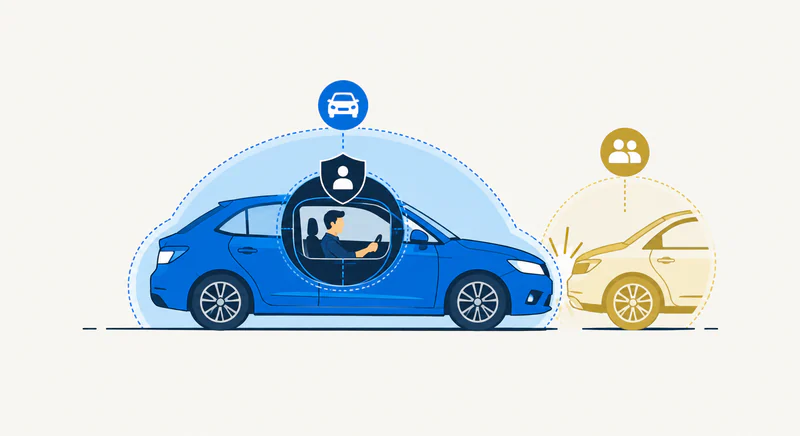

When a new or young driver joins the family, the insurer's quote can be surprising — sometimes by several hundred shekels a month for exactly the same car. This article explains why the rate is higher, which policy choices affect the price, and why hiding who actually drives the car can end up costing far more than it appears to save.
Why is the premium higher for young or new drivers?
Insurers calculate the premium based on a risk profile. Young drivers — typically under age 24 — and new drivers regardless of age are statistically more likely to be involved in accidents than experienced drivers. The gap is especially noticeable in the first years after getting a licence. Other factors that push the rate up: the car make and model, area of residence, family claim history, the chosen cover type and the deductible.
What affects the price — eight common factors
- Driver age and length of time holding a licence.
- Real driving experience — a new driver can also be aged 30 or older.
- Car make and model — more expensive cars or theft-prone cars are usually pricier on comprehensive cover.
- Cover type — mandatory alone is cheaper; comprehensive is more expensive.
- Deductible amount — choosing a higher deductible may reduce the premium.
- Driver restrictions — a policy limited to older drivers may be cheaper, but only if it reflects actual use.
- Anti-theft and safety equipment — alarm systems, dashcam, active safety systems.
- Mileage and how the car is used — daily commute vs. occasional trips.
How to reduce the premium — without giving up real cover
Several choices can lower the rate, subject to the policy terms — but every choice must reflect the real use of the car.
- Driver restrictions: only if the new driver really does not drive the car, or drives only occasionally with a supervising parent.
- Deductible: a higher deductible can lower the premium — but make sure you can absorb it at claim time.
- Car choice: moving to a less expensive or less theft-prone car reduces the cost of comprehensive cover.
- Compare insurers: the same profile can be priced very differently between insurers. Get multiple quotes.
- Dedicated young-driver tracks: some insurers grade the premium based on licence experience and years claim-free.
- Anti-theft installation: certified systems may reduce the premium and ease policy approval.
What must never be hidden from the insurer
It can be tempting to list only the older parent on the policy to keep the premium down. But hiding who really drives the car on a regular basis can lead to a claim being rejected — and that can cost far more than the apparent saving. The key facts to be accurate about: age and licence experience of every regular driver, whether the car is used for the young driver's studies or work, whether there is past claim history in the family, and whether the car is regularly parked in a public space. It is better to present the real picture and have a policy that will actually pay out than to save a few hundred shekels and discover the policy is invalid at the moment of truth.
How a family should choose cover responsibly
- Separate ordinary driving from the supervised-driving period of a new driver — some insurers price the supervised track differently.
- Check whether the young driver can be added to a family policy, or whether a separate policy makes more sense.
- Make sure the essential covers (mandatory, third-party / comprehensive as needed) are actually in place, even when compromising on rate.
- Update the policy at every material change — a new driver gaining experience, lower mileage, changing the car.
- Keep the insurance quotes received before signing so you have a comparison point at renewal.
Common mistakes
- Hiding the young driver from the policy — apparent saving, real risk of a claim being rejected.
- Cutting cover on an expensive car just to survive the first year of the new driver.
- Raising the deductible beyond the family's real financial capacity.
- Ignoring exclusions and anti-theft requirements in the policy.
- Not comparing the same profile across at least two insurers.
Car insurance hub — what each cover type includes
The car insurance hub explains what each cover type usually includes, what affects the price and how to compare offers properly.
Open the car insurance hubFrequently Asked Questions
At what age is a driver considered 'young' on the policy?
The threshold varies by insurer, but drivers under 24 or with less than one or two years of licence experience are usually priced at a higher rate. The exact definition appears in the policy and in the policy schedule.
Does a 30-year-old with a brand-new licence pay a high premium?
Yes, in most cases. Licence experience is a major factor, sometimes more than age. A new driver aged 30 will usually be treated as a 'new driver' on the policy even if not a 'young driver' purely by age.
What is a driver restriction clause?
A clause in the policy that limits cover to drivers meeting certain criteria — usually a minimum age and minimum licence experience. If a driver who does not meet the criteria causes an accident, the insurer may reject the claim.
What happens if a young driver causes an accident and is not listed on the policy?
If the young driver does not meet the driver-restriction terms, the insurer may reject the claim under the policy. There may also be a higher deductible or loss of no-claims discount. It is better to list and pay the difference than to hide the driver.
Is a separate policy for the young driver cheaper than a family policy?
Not necessarily. A standalone policy for a new driver is usually significantly more expensive, so adding to an existing family policy is often more efficient. Either way, get quotes for both scenarios and compare.
Is a higher deductible always worthwhile?
No. A higher deductible reduces the monthly premium but increases what you pay at claim time. Match the deductible to the family's realistic financial capacity, not only to the lowest possible premium.
Want a comparison for a new or young driver in the family?
An insurance portfolio review collects quotes from several insurers and checks what is actually worthwhile for your family's situation — no cost, no obligation.
Get a free portfolio reviewUnsure about adding a young driver to the policy?
Send me the driver ages, car details and claim history on WhatsApp — I'll come back with points to check.
Message me to talk it through